Pages

Thursday, August 11, 2011

Mobile Making - Using Drawing to Plan and Reflect

In our mobiles class this summer we built with wire, paper, recycled objects, string and ribbons. The challenge for young artists was often as much in figuring out attachment strategies as in creating a design. Tape became a popular media as did bendable pipe cleaners and wires.

We used drawing throughout the 3 days as a way to plan, to reflect on our creations and to think of new strategies and ideas.

Below, the artist arranges found and recycled materials on top of the plan she has drawn for a space-themed mobile.

With the addition of wire attachments, the mobile hangs as a sculptural creation.
The next 4 drawings show an artist using drawing as observation and reflection. The sculptures are shown first followed by the drawings created at the end of class to record our creations.
Notice the different shapes used for different parts and materials on the mobile.
The spy gear goggles seen here are drawn again below.
The goggle plan (below) proved helpful as other artists wanted to create their own gear.
In the sketches below the sculptor depicts the curve of the wire and then the individual beads arranged along it to create this unique small sculpture. In addition to reflecting on his creation, this artist gives us clues as to how it is constructed.
The artist below was careful to match the colors and metallic luster of her materials in recording her sculpture with a drawing.
Finally, this diagram of a moving sculpture with gears inside begins to function as a diagram, adding arrows and views inside to the moving parts. The artist/engineer begins to show and share his understanding of how the device works as he reflects on it through drawing.
Posted by Picasa

Monday, August 1, 2011

Book Making

Our book-making workshop this summer offered a great opportunity for thinking about working in series with our accordian mini-books and for making personal journals to fill with summer drawings, reflections and memories. See images below.


Posted by Picasa

Tuesday, July 12, 2011

Paper Architecture Creates Learning Environments

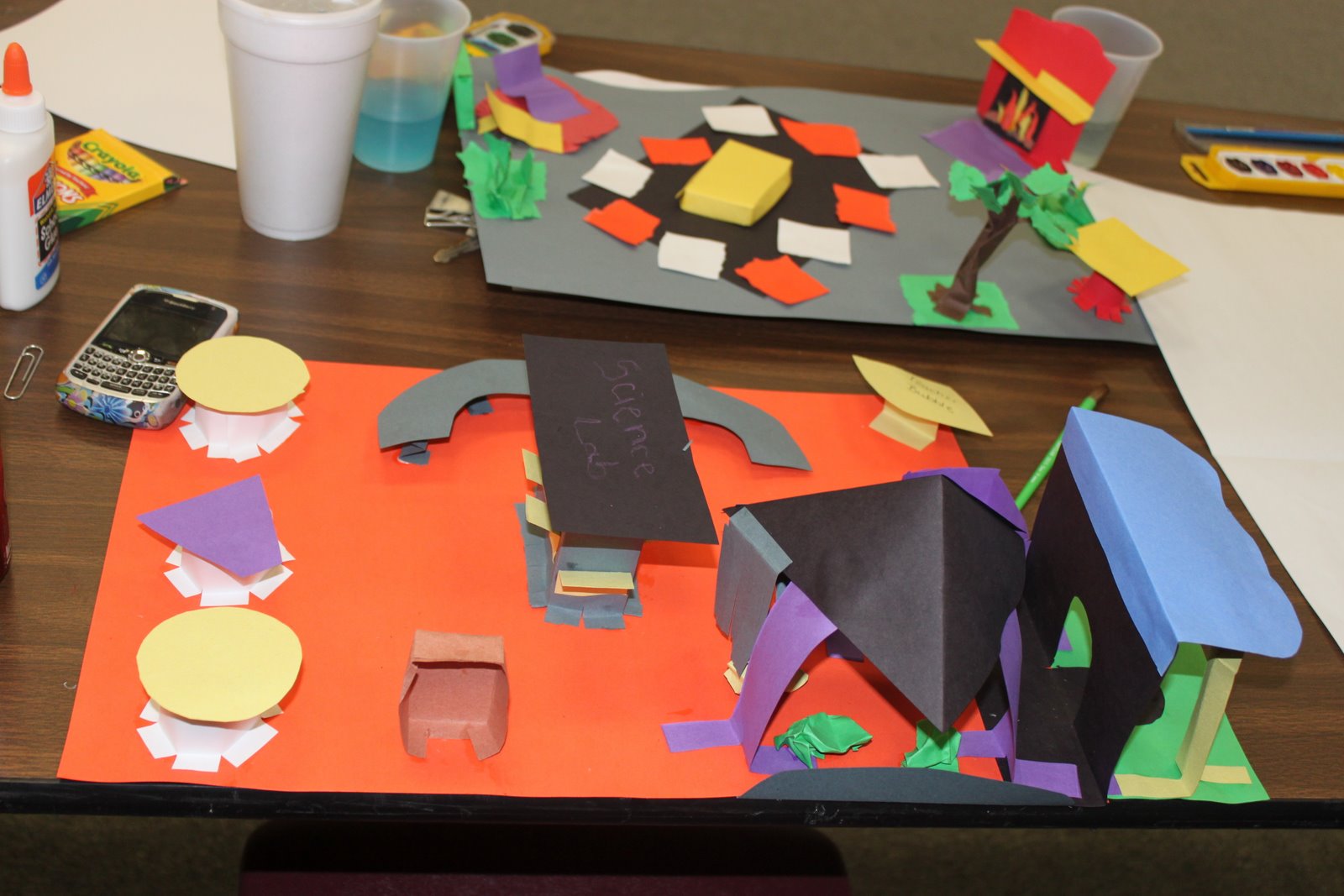
Below you will see additional images of learning environment designs created using a variety of paper building and collage techniques. Notice the color, variety and ingenuity used in the designs.
The above environment features symbols for resources such as funding, people and transportation to access learning opportunities beyond the classroom.
Natural and playful elements like the tree and the slide to enter the classroom make learning fun and exciting.
The environment above features a variety of working, meeting and seating areas as well as access to the outside (on the right).
The hearth adds warmth and a sense of home while the central circle features a meeting place that can transform and take advantage of technology by projecting on the ceiling depending on the needs of the learning meeting and subject.
Lofts, lots of books and cozy nooks for reading are of utmost importance.
This designer really valued quality supplies and took the care to create these mini supplies for her worktable.
Posted by Picasa

Art (Paper Construction) and Thinking Skills

In this workshop for upper elementary teachers, participants created ideal learning environments using paper sculpture and collage techniques.
The focus was on how art can help develop thinking skills and we took particular inspiration from the Studio Thinking Habits of Mind developed by Lois Hetland and Ellen Winner at Project Zero.
Paper architecture offers great opportunities for problem solving, inventing and creating using simple materials. Working in a group setting adds the added benefit of learning from the process and discoveries of other artists.
At the beginning of the day when we discussed goals several teachers mentioned working through perfectionism and fear of failure when drawing and making art with upper elementary students.
This sort of activity which begins with building and then presents drawing at the end as a tool for collaboration and communication can help get around some of those fears.
Below are a few different views of one group's combination of several learning environments to create a learning community.
The group had to take into consideration how to connect their learning environments and how flow and function would work together in a shared space.
The multi-level design allowed for great variety in use of space and highlighting features that worked together well.
The group drawing depicts the plan for connecting the different learning environments and presents a plan for a unified learning community.
Posted by Picasa

Thursday, June 30, 2011

Talking with Teachers in Texas - Art and Early Literacy

I wanted to use this post to share and celebrate my day spent with K-2 teachers in Hereford School District. We explored art and literacy connections, specifically looking at developmental stages of artistic development and discussing how the Studio Thinking Habits of Mind developed at Project Zero can relate to classroom art workshop practice. Taking inspiration from the popular children's book author, Eric Carle teachers created collages using painted papers. We combined oil pastel, crayon and watercolor to paint designs and then combined these with torn paper to create unique narrative collages. Check out the great variety of techniques and subjects below.
Just imagine the stories we could tell with these great collages!


Posted by Picasa

Friday, May 20, 2011

Learning, Mastery and Communicating Ideas

I want to begin this post with a quote from one of my all-time favorite books on art for children (and adults) Doing Art Together by Muriel Silberstein-Storfer.
When anyone learns to ride a bicycle, usually after much effort on the part of both the guiding person and the beginner, he or she rides at first for the sheer joy of making the bike move and pleasure in controlling it. When the bicycle finally becomes a vehicle for exploration, transportation, and adventure, it is an instrument of new experience. Similarly, when anyone starts to work with art materials, he or she experiences this same exhilaration of moving the medium and controlling the brush and colors. After gaining control, studio work becomes involved with movement or communication of ideas.
This metaphor is a great illustration of the learning that happens when children are allowed an open-ended environment and opportunities to explore media. Each moves through the developmental stages of art in his or her own time and many have a favorite way of working that often precedes important new risks and adventures in communication and meaning.
Below are 3 paintings completed in one afternoon.

In this case the paintings were completed during our warm-up time, we offer a circle drawn in pencil on the page as a starting point. This mandala form provides a starting point for kids and a common routine to begin exploration of different media.
This young artist is very tactile and really enjoys exploring the sensory quality of materials and the flowing nature of the paint. The painting on the left, completed first is typical of his paintings in class. The page is full of color and brush strokes are clear moving through the thick paint.

Above, the artist begins his first painting with some awareness of the circle. As he continues in the picture below the joy of just moving the flowing colors takes over and he covers the page.
His second painting shows a bit more awareness of the shape on the page. There is still the characteristic blocks of color and visible brush strokes but a beginning of shaping the painted strokes to the circle shape.

Other children at the table chose to use the circle form to paint faces. While working on his second painting, the artist began to talk about painting a portrait of his friend from school. The awareness of the circle seemed to be a first step toward thinking about a face.

The third painting of a face was a real step forward for the artist in choosing to do a representational image and to follow through on his idea to paint a portrait. He began with eyes, nose and mouth.
He added the hair and finished with the neck and ears, narrating as he added each detail.
The series of paintings below are a lovely illustration of moving from the pure joy of materials to beginning to communicate ideas - in this case to portray a friend using those materials.

Posted by Picasa