Saturday, December 22, 2012


Thursday, November 29, 2012
Family Moving Sculpture Workshop

Drawing a plan first helped builders to imagine the design of their sculpture and how the motor part would be incorporated into the design.

This plan focused on adding the legs - the face flips up to get to the switch to turn int on.

Father and son working together allows for great exchange of ideas as they problem-solve.

Mother and daughter work together lending a helping hand with tools.


Daddy bug.

Rebecca.

Fizzy cannon ball - it vibrates and spins.

This one is for sale by its proud creator!
Thursday, October 4, 2012
Take the Cardboard Challenge this Weekend
Last spring a friend and fellow art
teacher sent me a link to a You Tube video entitled, Caine's Arcade.
It features a nine year old boy named Caine and the fabulous
cardboard arcade he built over the summer in his father's auto-parts
store in east Los Angeles.
The story is told by Nirvan Mullick, an
independent film-maker who was his first customer. The detail,
dedication and ingenuity in the cardboard arcade are remarkable as is
Caine's dedication to his project in spite of initially having very
little audience for his work. The film features the flash-mob event
organized by Mullick to suprise Caine as well as interviews with his
dad about the building of the arcade and images of his many game
creations.
What really excited me about the
project was how accessible it is to kids and families. Cardboard and
tape seem to be universal building blocks of childhood. In his
interview Caine's father said he was glad the arcade kept his son
busy and engaged during the long summer days. He encouraged and
supported the project without getting too involved. When Caine
wanted to go buy a special part for a particular game, his father
challenged him to make one and was surprised and delighted by Caine's
inventive solution.
Watch the origial Caine's Arcade video
for yourself here:
Then move on to the second video:
Anyone can participate and it is a
great reminder of ingenuity and creativity that can be found by
building with simple everyday materials.
During classes at Art at the Center we
have been building and experimenting with ways to create with
cardboard and some of our discoveries are pictured below.
We encourage you to gather your boxes
this weekend and enjoy some time over the 3 day weekend creating with
cardboard with your children, family, friends and neighbors.
Email us photos of your creations and we will post them to inspire other builders!
Related stories:
Friday, September 7, 2012
BIG CHALK DRAW 2012
Thank you to everyone who joined us August 31 for our 4th Annual Big Chalk Draw in the Art at the Center parking lot.
See the link below for a time-lapse video of the transformation of the lot from a blank slate to a field of color.
See the link below for a time-lapse video of the transformation of the lot from a blank slate to a field of color.
Monday, April 23, 2012
3rd Anniversary Collage Event
Thank you to all who joined us for our 3rd Anniversary Community collage event. We collected several bags of food and donated $100 to United Community Ministries.
Below are some highlights of the afternoon made by artists of all ages.
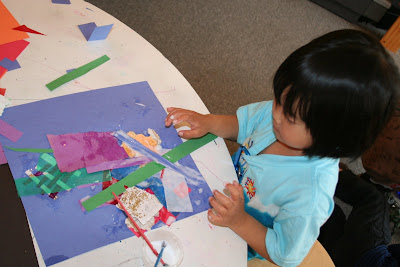
Many layers and LOTS of glue make for a captivating collage process.
Below are some highlights of the afternoon made by artists of all ages.

Many layers and LOTS of glue make for a captivating collage process.

A collage for a friend who is moving home.

Everything in this one Bounces!

Collage turns 3D with this paper tree sculpture.

Which inspires a great village of standing paper houses.

Finally, an elaborate labyrinth created on the floor reminds us of the wonderful connections between collage and play.

Wednesday, January 18, 2012
Building Skills with Blocks
On January 12 our Art Focus Group met for a focus on block play. It was met with great enthusiasm by all participants.

We began with a simple exercise designed to encourage focus, concentration and non-verbal communication. Pairs were seated at a table with a sheet of paper and identical sets of blocks. Builders took turns building and following, with the only requirement being that they pair not speak - they were to use non-verbal communication to lead and follow.

We also discussed how a similar activity could be done "back to back" or with a partition to prevent seeing the partner's blocks. Then the challenge is to develop a workable and descriptive language for describing placement and interaction of pieces so the partner can replicate the design without seeing it.
Either way this activity improves focus and concentration while offering kids an opportunity to work collaboratively and take turns as leader and follower.
As we continued with our discussion and exploration of building materials in the classroom, there was a general consensus of the delight in bringing blocks to the table to offer each child a spot to build and a small group of blocks for building. As we spoke, participants changed and played with different designs, exploring balance, symmetry, layering and just having fun.
While many classrooms have a blocks center or class set of blocks used during play and exploration time, this bringing blocks to the table helps to make more transparent the great learning that is going on in building in a classroom. It allows the adults as well as the kids a chance to focus in on one material and the many things kids can do with blocks.
For our explorations, we continued with adding drawing as a way to reflect on our buildings. Each participant built a structure or design and then sketched this design with a pencil.
Reflecting afterward on the experience, the main description was "intense" - careful observation and representation of space and objects in drawing is intense - for adults and for kids. I think it is this intensity that I so enjoy observing when children draw what they build. Having built and manipulated the blocks first, they have an added felt knowledge of their building and a commitment to representing and saving their built idea on paper.
We also discussed teachers using drawing as a visual note-taking to record children's buildings. Time can be a constraint and most participants (myself included) use photography as it is quicker and easier. We discussed the important modeling that can happen if kids see adults drawing as a way of remembering and note-taking.
Often it seems adults hesitate to draw with and around kids for fear of influencing or intimidating children with their greater skill. At the same time when the drawing is purposeful and a real act of observation it serves as a great model for kids of ways to record and remember. Just as adults taking notes doesn't shut down kids' desire to write, adults taking visual notes doesn't have to shut down kids' desire to draw. It is really about the adult being engaged in his or her own process and in that way modeling engagement for the child.
The following article presents some great examples of the advantages of teacher visual note-taking of children's block buildings:
We also discussed using blocks and building to access things that kids (or adults) may know with their hands and their senses but not yet be ready to explain in words. Often children may have knowledge and ability with materials that is greater than their language development. Learning can be frustrating not because they don't understand how to DO but because they don't understand how to represent on paper and tell about it. One way to build on these children's strengths is to focus on what they build and work toward the linguistic and symbolic communication by asking how they could represent or give directions to another builder to replicate what they have done. This act of recording and remembering can help move from the in the hands knowledge to linguistic and symbolic communication of that knowing. One book that describes this process and the hand-brain learning connection quite well is The Hand by Frank R. Wilson.
Our block building explorations throughout the evening were full of joy and excitement and many great stories of the strengths kids show in building in the classroom.
Here are a few stories of building and drawing in the studio lab at Art at the Center for further examples of the rich explorations that take place with building materials:
Tuesday, January 10, 2012
Light Painting with the DC Area Reggio Study Group

The DC Area Reggio Study Group gathered at Art at the Center on December 13 for an evening of exploration drawing and painting with light.
Light painting has become a winter tradition at Art at the Center with an annual Light the Night painting event held on the longest night of the year each year.
With this smaller, more intimate group it was possible to explore light drawing as well as discuss some of the implications on learning of this sort of activity.
Reggio-inspired educators stress intentionality and learning from process-based experiences. In this case the phenomena of light movement captured by camera became the provocation for our discussion.
An advantage of this group gathering was the participants' abilities to describe personal experience as well as to reflect on how this might impact our experiences with this media with children.
Below are some of the photos created followed by observations and reflections.


Observations:
Feeling uncomfortable - this was something new, something never tried before.
Complete misunderstanding of the idea based on the verbal description ...until given the opportunity to try it...then it made sense, the participant had to see and participate to understand.
There was a need to start with the basic idea first and then build toward more complexity, with experience came the ability to predict outcomes.
Another participant found that she had the most joy and delight in just playing with light and movement and that when she tried to think and plan it took some of the joy of the moment out of the experience. She saw a connection to the infants she teaches and their ability to be fully in the moment with wonder and joy.
In our set-up the camera was connected to a monitor for instant feedback. The light drawings were displayed immediately after they were made. It was discussed how the experience might be different without the instant feedback, if, for instance, the photos were not seen until they were printed and brought back to the group.
Reflections:
Based on the feelings and experiences shared above, we discussed how using a medium that is unfamiliar to adults puts adults on the same page as kids and allows them to experience some of the uncertainty and discomfort of trying something new. This sort of activity could be a good discussion starter for a group of parents or teachers.
We also discussed the idea of creating an "alphabet" or vocabulary of light images based on different movements with children. This would allow children to explore re-creating and remembering their experience. In addition to creating a physical record of the movement, they could work from a collection of types of marks made by movements to compose more complex movement paintings.
To prepare for this meeting, we read the chapter "Ray of Light" from the latest Wonder of Learning exhibit catalog by Reggio Children.
The quote below seemed to relate to our own experiences of wonder and joy in this process as well as our reflections on bringing the experience to children and community groups.
Our challenge is to stand beside children with an approach to reality which provides oxygen to and makes sense of the scientific thinking which is already a natural part of the hman species, but which needs to be exercised, supported and informed.It is therefore important to offer specific and stimulating contexts and situations focusing on the idea that science questions, and is curious about, what cannot be explained by the senses - what lies beyond the visible - and seeks out starting data in order to research, test, and establish connections between things which are un-joined, observe the results and develop further tests and hypothesis.Reggio Children, 2011 p123
Subscribe to:
Posts (Atom)